
Many operators, one platform,
nobody sharing a console.
Wholesale carriers, white-label hosts and ISPs with local operators beneath them all have the same problem: one physical estate, several businesses on it, and each of those businesses expecting to see its own network and nobody else's.
The moment you carry subscribers for someone else, your monitoring stops being an operations tool and becomes something your customer is entitled to look at.
Three audiences, and they must not see the same thing
The mistake that makes wholesale platforms unsellable is treating this as one product with a permissions checkbox. It is three distinct surfaces with three different jobs.
A tenant is an operator, and it owns things
Each operator on the platform is a first-class account rather than a label attached to some servers. Gateways belong to exactly one of them, and everything downstream of that — sessions, alerts, capacity, reports — inherits the same boundary.
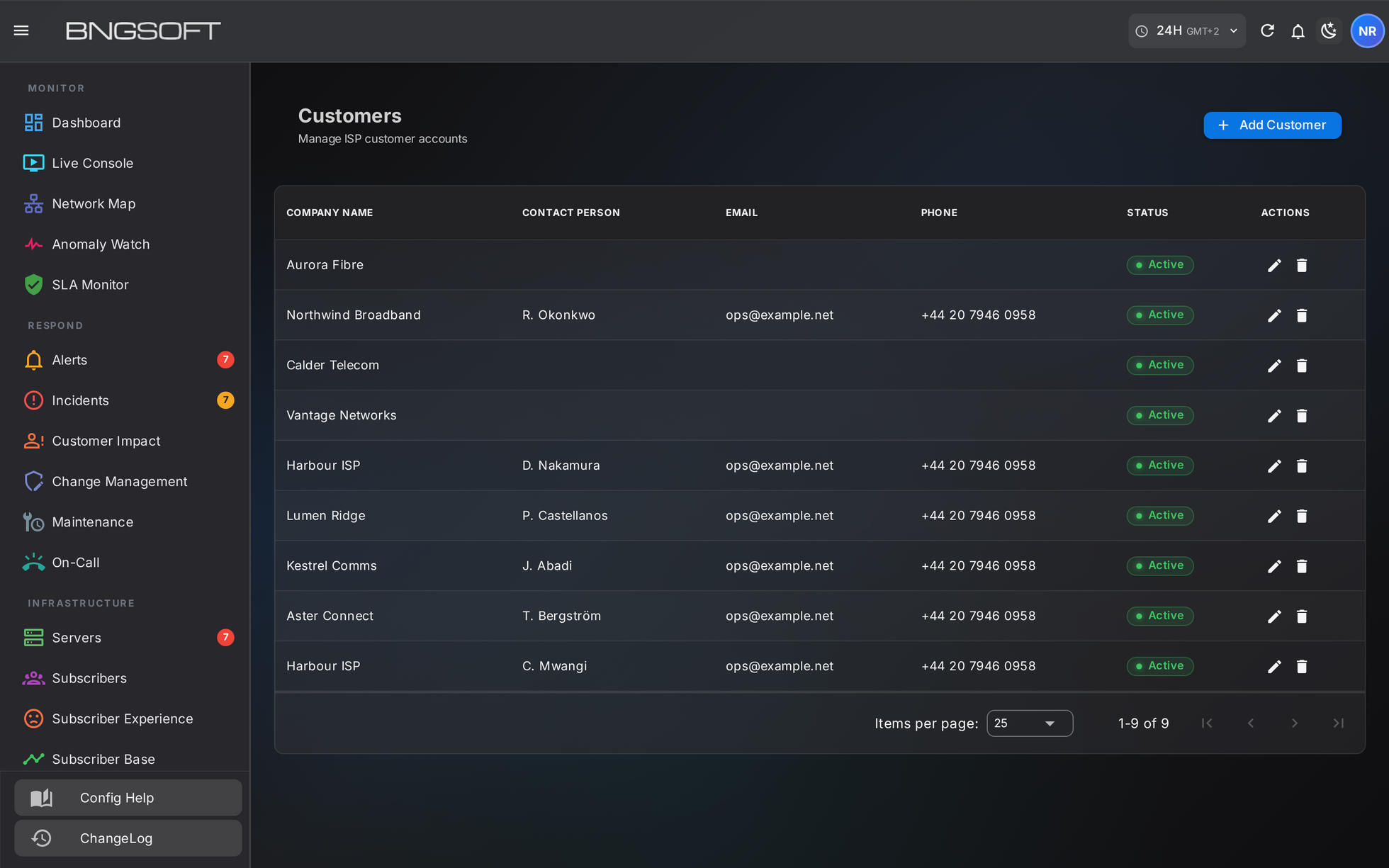
What each operator gets to control
| Per operator | What it means |
|---|---|
| Its own gateways | Every gateway is owned by one operator. Their staff see those and nothing else — in lists, in searches, in alerts and in every figure computed from them. |
| Its own staff logins | Accounts scoped to that operator, with roles from the same permission set you use. A user can also be assigned to more than one operator where that is genuinely wanted. |
| Its own subscriber portal | A separate sign-in for their end customers, at their own address, showing one subscriber their own connection. |
| Its own status page | A public page for their customers, which can be switched on or left off per operator. |
| Its own identity | Logo and welcome text on the surfaces their customers see, so the page reads as theirs rather than as yours. |
| Its own change policy | A per-operator threshold for how much change requires approval — a cautious wholesale customer can be cautious without imposing it on the others. |
| Its own reporting | A weekly digest per operator, and a currency per operator for anything with money in it. |
The surface their subscribers actually touch
This is the part wholesale platforms usually lack entirely, and it is the one your operator's marketing department will ask about first.
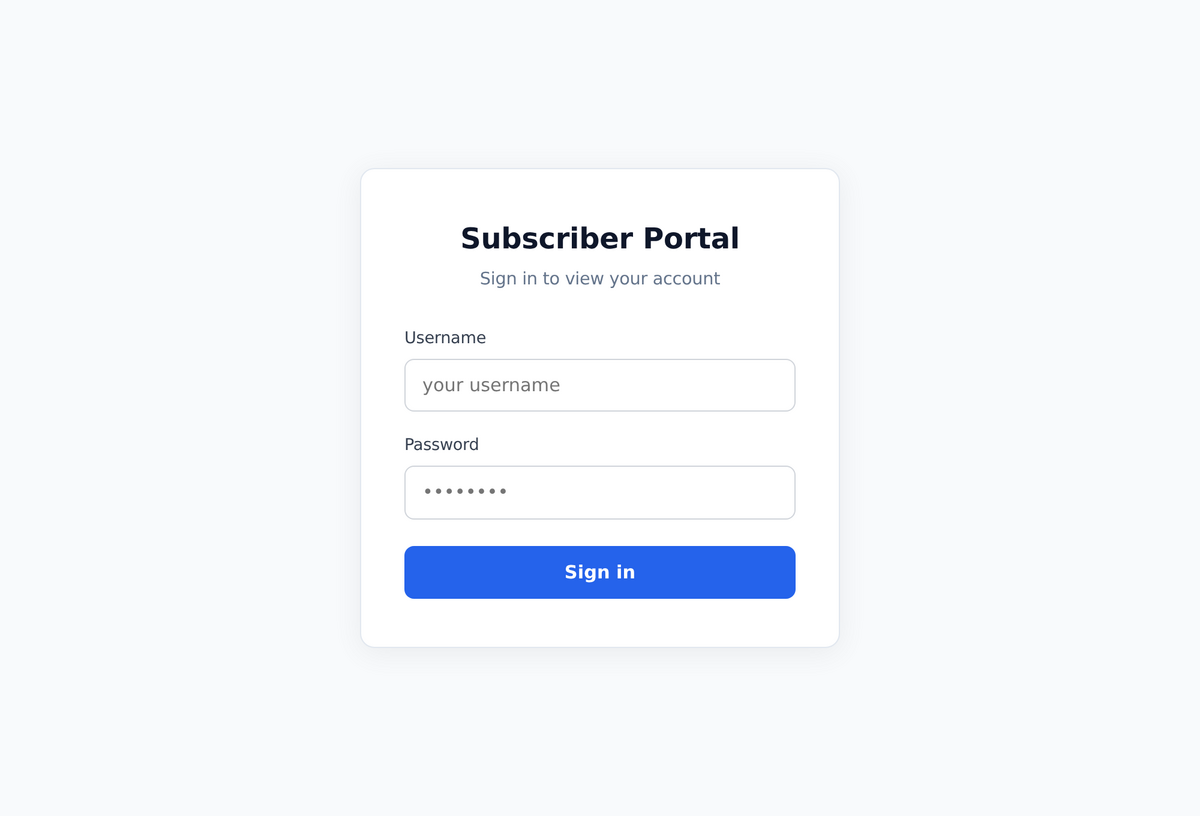
An operator beneath an operator
Some wholesale structures are two layers deep: a regional ISP holds the commercial relationship, and local operators sit beneath it serving their own subscribers. The tenant model handles this directly — an operator can be recorded as the parent of another, and an administrator at the parent can see the child's estate while the child sees only its own.
The hierarchy is one level deep by design. Parent sees child; it does not walk an arbitrary tree. We would rather state that plainly than let you design a four-tier reseller programme around an assumption. If your structure is deeper than that, tell us before you sign anything.
Why isolation has to be structural
Filtering at the page
Each screen remembers to apply the operator filter. It works — until someone adds a screen, an export, a report or a search, and forgets.
The failure is silent and it is discovered by the customer who was shown someone else's network.
Resolving in one place
"Which gateways may this account see" is answered by a single authority that every query goes through, rather than re-implemented per page.
A new screen inherits the boundary because there is no other way for it to obtain the list in the first place.
What it changes commercially
One estate, many contracts
Gateways are a shared physical investment; operators are separate commercial relationships on top of it. Adding a customer does not add a platform to run.
The console is part of the product
Wholesale bandwidth is a commodity argued on price. Wholesale bandwidth where your customer can see their own subscribers, alerts and outages is a different conversation.
Their customers see them
The portal and status page carry the operator's identity. You supply the network; they keep the relationship — which is usually the condition of them buying at all.
The bottom line
If you carry traffic for anyone other than yourself, the question is not whether your platform can be shared. It is whether the sharing is structural or remembered — because the second kind fails exactly once, in front of the customer least willing to forgive it.
Nine operators run on one deployment today, across eighty gateways carrying just over three hundred thousand live sessions, with each operator's staff seeing only their own.
About the screenshots. Every screen shown is a real production console. Operator names, contact names, contact details, gateway hostnames and site names are all replaced with placeholders before the image is taken; no real operator, person, site or subscriber identifier appears in any image.